Payroll Deduction Calculator for Benefits: Complete Guide (2026)
"How much will come out of my paycheck?" It's the question every employee asks during open enrollment. Getting payroll deductions right—down to the penny—is essential for employee trust, payroll accuracy, and carrier payment reconciliation.
Why Payroll Deduction Accuracy Matters
Incorrect payroll deductions create cascading problems:
- Employee complaints: Workers notice when their paycheck is different than expected
- HR overhead: Fielding questions and making corrections consumes time
- Carrier reconciliation: If deductions don't match premiums, someone pays the difference
- Trust erosion: Repeated errors make employees question benefits competence
- Compliance risk: Incorrect pre-tax deductions can create tax issues
The good news: payroll deduction math is straightforward once you understand the fundamentals.
The Core Formula
Every payroll deduction calculation follows the same basic formula:
The foundation of all payroll deduction calculations
The complexity comes from determining the correct number of pay periods and handling edge cases like mid-year enrollments, rounding, and multiple benefit lines.
Pay Frequency Reference Guide
The number of pay periods per year varies by pay frequency. Here's the complete reference:
| Pay Frequency | Periods/Year | Schedule | $6,000/yr Example |
|---|---|---|---|
| Weekly | 52 | Every Friday | $115.38 |
| Bi-Weekly | 26 | Every other Friday | $230.77 |
| Semi-Monthly | 24 | 1st and 15th | $250.00 |
| Monthly | 12 | Last day of month | $500.00 |
Critical Distinction: Bi-Weekly vs. Semi-Monthly
The most common payroll deduction error is confusing bi-weekly (26 periods) with semi-monthly (24 periods). This creates a 7.7% error—significant when multiplied across all employees. Always verify the pay frequency with HR or the payroll administrator.
Step-by-Step Calculation Process
Step 1: Determine Annual Employee Cost
Start with the total annual premium, then calculate the employee's share:
- Monthly premium: $850 (from carrier rate sheet)
- Annual premium: $850 × 12 = $10,200
- Employer contribution: 75% = $7,650
- Employee cost: 25% = $2,550/year
This employee cost is what gets divided into payroll deductions.
Step 2: Identify Correct Pay Frequency
Confirm the employer's pay schedule. Don't assume—ask specifically:
- How many pay periods per year?
- What day of the week/month is payday?
- Are there any "extra" paychecks in certain months?
Step 3: Calculate Raw Per-Period Amount
Divide annual cost by periods:
Bi-weekly example: $2,550 ÷ 26 = $98.076923...
Step 4: Handle Rounding
Payroll systems typically work in whole cents. You need to round, but rounding creates a reconciliation problem:
- Round to $98.08: 26 × $98.08 = $2,550.08 (overpay by $0.08)
- Round to $98.07: 26 × $98.07 = $2,549.82 (underpay by $0.18)
Step 5: Reconcile the Annual Total
To ensure exact reconciliation, adjust one pay period. Common approaches:
- First-period adjustment: Deduct $98.26 first pay period, $98.07 for remaining 25
- Last-period adjustment: Deduct $98.07 for 25 periods, $98.25 for final period
- Annual true-up: Accept small variance and adjust at year-end
Complete Calculation Example
Scenario: Family coverage, bi-weekly payroll
Monthly premium: $1,420
Annual premium: $1,420 × 12 = $17,040
Employer pays: 70% = $11,928
Employee pays: 30% = $5,112
Per-paycheck (raw): $5,112 ÷ 26 = $196.615...
Per-paycheck (rounded): $196.62
Annual total if all same: $196.62 × 26 = $5,112.12
Adjustment needed: -$0.12
Solution: $196.62 × 25 + $196.50 × 1 = $5,112.00 ✓
Special Situations
Mid-Year Enrollments
When an employee enrolls mid-year (new hire or qualifying event), prorate the annual cost:
- Calculate months remaining in plan year
- Prorate annual cost: (Annual cost × Months remaining) ÷ 12
- Calculate remaining pay periods from enrollment date to plan year end
- Divide prorated cost by remaining periods
Example: Employee enrolls October 1 with a January 1 plan year. That's 3 months (Oct, Nov, Dec) or 6 bi-weekly pay periods. If annual cost is $2,400, prorated cost is $600, and per-period deduction is $100.
Multiple Benefit Lines
Most employees have multiple deductions: Medical, Dental, Vision, FSA, HSA. Best practice:
- Calculate each benefit line separately
- Round each line individually
- Sum for total deduction
- Don't try to "net" rounding across lines—it creates confusion
Pre-Tax vs. Post-Tax
Most health insurance deductions are pre-tax under a Section 125 cafeteria plan. However:
- Domestic partner coverage: Often post-tax (imputed income)
- HSA catch-up contributions: Must be separate deduction for 55+ employees
- After-tax Roth 401(k): Different treatment than pre-tax
Ensure the payroll system codes each deduction correctly for tax treatment.
Months with Extra Pay Periods
For weekly and bi-weekly schedules, some months have extra pay periods. In a bi-weekly schedule, two months per year have three paydays instead of two.
This doesn't change the per-period deduction calculation (still 26 periods per year), but it does affect monthly cash flow for both the employee and the employer.
Common Mistakes to Avoid
Mistake 1: Using Monthly Rates for Non-Monthly Payroll
Don't divide monthly premium by 2 for bi-weekly. The math doesn't work: $500/month ÷ 2 = $250 × 26 = $6,500. But $500 × 12 = $6,000. That's $500/year overcollection.
Mistake 2: Ignoring Rounding Accumulation
A $0.05 rounding error per period becomes $2.60/year for bi-weekly payroll. Across 200 employees, that's $520. Small errors compound.
Mistake 3: Not Updating for Rate Changes
When renewal brings new rates, deductions must update immediately. A one-month delay on a $50/month increase is $50 that needs to be collected somehow.
Mistake 4: Inconsistent Treatment Across Employees
If you adjust the first paycheck for some employees and the last for others, reconciliation becomes a nightmare. Pick one method and apply consistently.
Automating Payroll Deductions
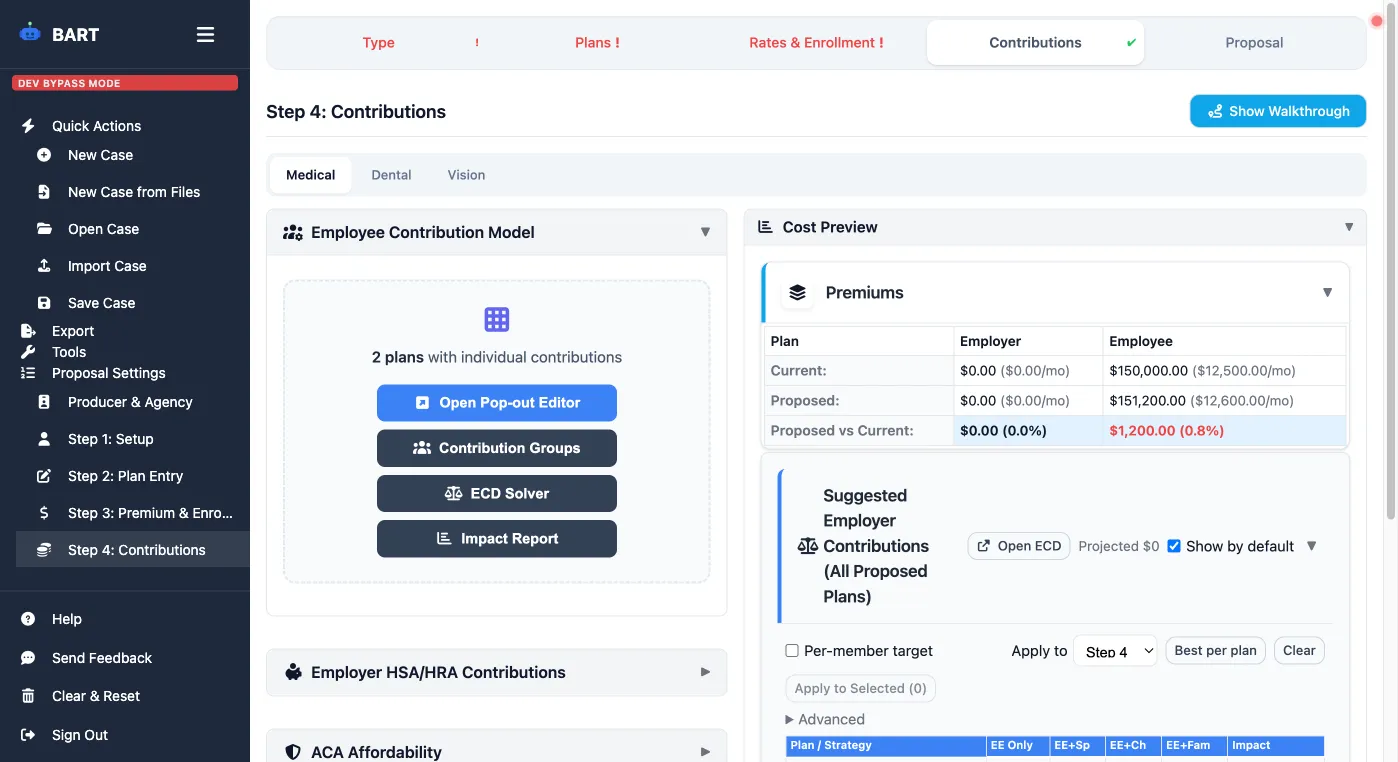
Manual calculation is error-prone, especially for companies with multiple plans, tiers, and pay frequencies. Modern benefits tools automate:
- Calculation for all pay frequencies simultaneously
- Rounding reconciliation with adjustments
- Mid-year proration for new enrollments
- Multiple benefit line handling
- Export files formatted for payroll system import
- Automatic recalculation when rates change
Calculate Deductions Instantly
BART automatically calculates accurate payroll deductions for any pay frequency, handles rounding reconciliation, and exports payroll-ready files.
Validation Checklist
Before finalizing payroll deductions, verify:
- ☐ Annual deductions equal annual employee cost (to the penny)
- ☐ Each benefit line calculated and rounded separately
- ☐ Pay frequency matches actual payroll schedule
- ☐ Pre-tax vs. post-tax coding is correct
- ☐ Mid-year enrollments properly prorated
- ☐ Deduction start date aligns with coverage effective date
- ☐ Export format matches payroll system requirements
Conclusion: Precision Builds Trust
Payroll deductions touch every employee every pay period. Getting them right demonstrates competence and builds confidence in the entire benefits program. Getting them wrong—even by small amounts—creates doubt and frustration.
Whether you calculate manually or use automation tools, the principles are the same: understand pay frequencies, handle rounding deliberately, and verify that annual totals reconcile exactly.